This article is written by Kyriba
Imagine a world where manual processes and guesswork don’t bog down forecasting. Instead, your forecast is created easily using real-time data and predictive analytics. This is the potential of artificial intelligence (AI) in modern financial operations; this is the power of AI in cash forecasting.
AI’s ability to process vast amounts of financial data in real-time, predict cash flow trends, and provide actionable insights is already changing the game for Treasury teams. These advancements enable organizations to navigate economic volatility with unprecedented precision and confidence in the accuracy of their forecasts.
Traditional Cash Flow Forecasting Methods Contribute to Liquidity Gridlock
Cash flow forecasting is a cornerstone of Treasury management. Traditionally, the process has relied heavily on historical data, manual data entry, and complex spreadsheets, requiring Treasury teams to spend considerable time consolidating data from multiple sources, which leads to inefficiencies and inaccuracies.
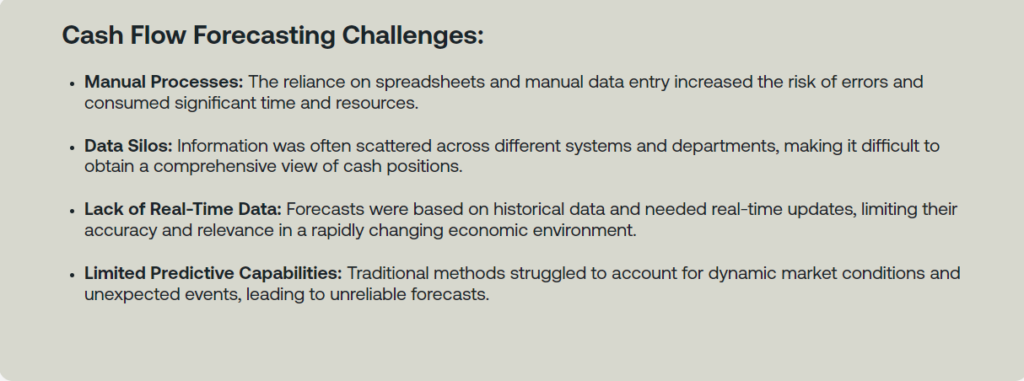
The time-intensive nature of these traditional methods means that treasury teams are often operating one step behind and with increasing volatility in the market, that can be detrimental to future growth. Staying ahead of the curve demands a more efficient, accurate, and dynamic approach to cash forecasting–one that AI is uniquely positioned to deliver. By leveraging AI, organizations can become better equipped to handle economic uncertainties and make informed decisions.
The shift from simple forecasting to a broader liquidity planning approach involves surrounding traditional cash flow forecasts with real-time data from diverse sources. This expansion allows organizations to formulate a true enterprise liquidity strategy, helping them understand and manage liquidity risk while ensuring financial stability and resilience.
It All Begins with a Data Strategy
A critical component of AI in cash forecasting is having a robust data strategy in place that specifies how a company collects, stores, manages, and analyzes its data.
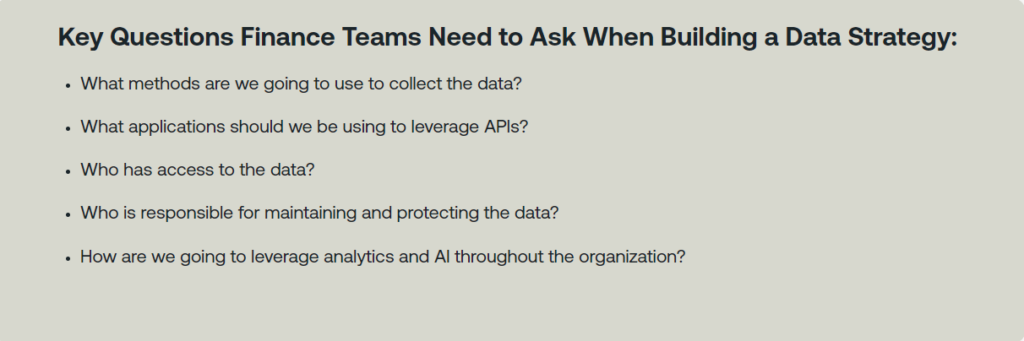
Having the right data strategy is a game changer and an essential first step for integrating AI, and real-time insights, into your cash forecasting.
By tapping into real-time data processing, treasury teams can craft a full picture of their company’s liquidity and thus are better equipped to make quick, informed decisions, and optimize their liquidity performance.
Additionally, introducing real-time data into the cash forecasting process helps mitigate risks- something any CFO would be happy to hear. Through scenario planning and sensitivity analysis, companies can gauge how changes in the economy, environment, and customer behavior might impact their financial position, allowing them to tweak their strategies, hedge against risks, and stay one step ahead.

Connect All Data Sources to Activate the Full Benefits of AI
Once a data strategy has been established, the next step is connecting all of your data sources to a single source of truth a.k.a. a data lake. By ensuring seamless integration and communication between banks, ERPs, applications, and data trading platforms, you provide the fuel AI uses to leverage intelligence capabilities effectively. This approach is specific to your organization which means that the outcome is hyper-relevant and extremely context-rich.
With a data lake in place, AI tools can quickly analyze vast amounts of integrated data. This provides context-rich insights that enhance the precision of your forecasts and make it easier to achieve financial stability and business resilience. Leveraging AI for cash forecasting and liquidity performance management has enabled organizations to achieve remarkable outcomes:
$1.04M
average net interest benefit from 47%+ reduction of idle cash
$55M
average free cash flow per $1B revenue from Supply Chain Finance program
87%
reduction in overall risk impact with BI-enabled exposure management
Source: Kyriba Value Engineering Analysis of 341 Corporations
Top Applications of AI in Cash Forecasting
The integration of AI in cash forecasting extends beyond basic financial management, offering solutions that are as varied as they are impactful. Some key applications where AI is making a significant difference are:
- Predictive Analytics and Demand Forecasting: AI excels in analyzing historical data to predict outcomes. This capability allows businesses to prepare more accurately for future financial needs, aligning their budget and resources with anticipated trends.
- Financial Markets Forecasting: AI algorithms are adept in sifting through vast amounts of market data to forecast stock prices, interest rates, and other financial indices. This application is invaluable for treasury managers, who need to anticipate market movements to manage assets and liabilities effectively.
- Supply Chain Optimization: AI helps identify potential bottlenecks and predict demand fluctuations in the supply chain. By providing a clearer picture of the supply chain dynamics, AI enables companies to optimize their operations, reduce costs, and improve overall efficiency.
- Customer Behavior Prediction: Understanding and predicting customer behavior can lead to more tailored marketing strategies and improved customer service. AI analyzes data from past purchases, market trends, and customer interactions, helping companies anticipate customer needs and preferences.
These applications enhance the accuracy of cash flow forecasting and broaden the scope of overall financial strategy, making it more powerful and responsive to both internal and external changes. By harnessing AI, organizations can both improve their immediate financial forecasting abilities and strengthen their strategic planning capabilities to set themselves up for future success.
Just Scratching the Surface
In a recent webinar, Kyriba’s Viena Swierczek, Solution Engineer, and Lisa Husken, Value Engineer, highlighted how AI, especially as it relates to cash forecasting, refines existing processes and paves the way for groundbreaking approaches in financial management. “AI is not just about automating existing processes,” Lisa Husken, Kyriba Value Engineer, said. “It’s about enabling entirely new ways of thinking about financial strategy and execution.”
“We are just scratching the surface of what AI can do in the financial sector,” Viena Swierczek added. “The next few years will be crucial in defining how deeply integrated AI becomes in our everyday decision-making processes.” This forward-thinking perspective invites finance leaders to consider the broader opportunities of AI beyond immediate operational improvements.
Read more from Kyriba
- Decoding the Impact of ChatGPT for Treasury
- Optimize Your Cash Forecasting with AI
- The Threat of Deepfake Frauds in Payment
- Fiat Currency Management Crypto Challenges
- Navigating Financial Flux: CFOs Perspective on Strategic Treasury Management
- 10 Things You Need to Know about APIs for Treasury
- The Risks of Not Adopting a Treasury Management System
- Embedded Finance to Embedded Treasury: Are Corporates Ready for the Transition?
- ChatGPT for Treasury: The Good, the Bad, and the Scary
- How API and ERP Integrations Are Transforming Corporate Treasury
- A New Practice Area Emerges for CFOs: Enterprisewide Liquidity Management
- Identifying the ROI in a Treasury Transformation Project
Join our Treasury Community
Treasury Mastermind is a community of professionals working in treasury management or those interested in learning more about various topics related to treasury management, including cash management, foreign exchange management, and payments. To register and connect with Treasury professionals, click [HERE] or fill out the form below to get more information.