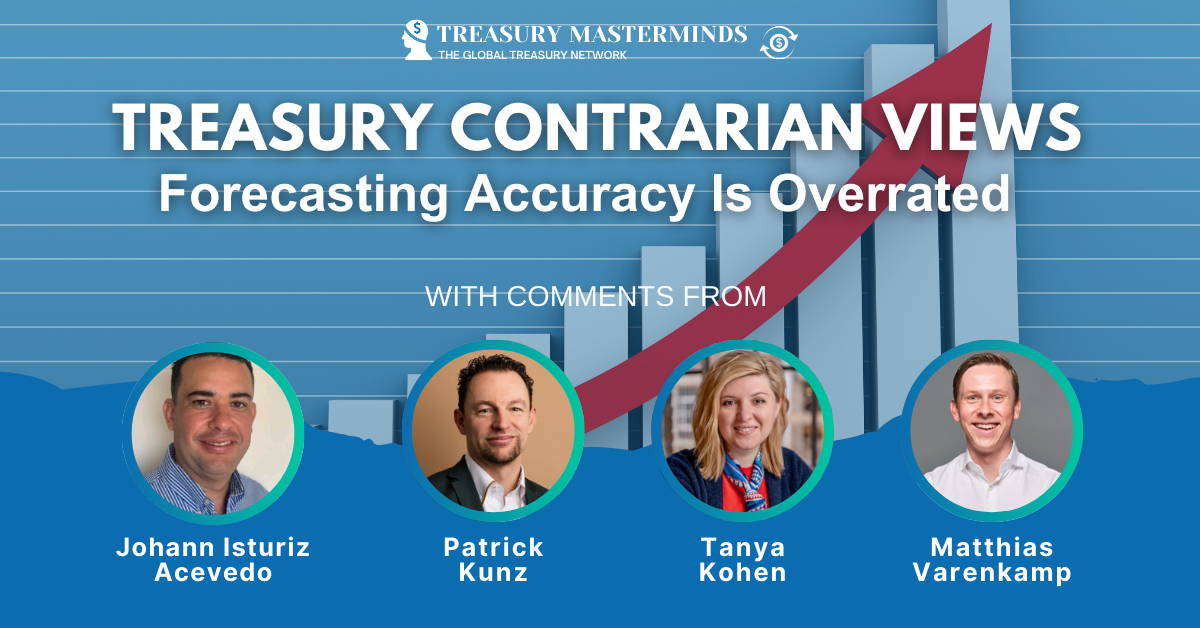
Cash forecasting is often described as the holy grail of treasury. Countless hours are spent fine-tuning spreadsheets, implementing new tools, and chasing the elusive “perfect forecast.” But here’s the contrarian view: forecast accuracy is overrated. What matters more is flexibility, adaptability, and decision-making agility.
Why Forecast Accuracy May Be Overrated
- Forecasts Are Always Wrong
- No matter how advanced the model, forecasts rely on assumptions that will inevitably change. Markets move, customer payments shift, suppliers delay, and forecasts go out the window.
- Diminishing Returns
- The effort required to move from 80% accuracy to 95% is enormous. The extra time and resources often add little incremental value.
- Static Forecasts in a Dynamic World
- Forecasts are snapshots. By the time they’re finalized, conditions may already have changed, reducing their usefulness.
- The Illusion of Control
- Focusing on accuracy can give management false confidence. The forecast looks precise, but reality rarely plays along.
What Matters More Than Accuracy
- Agility and Responsiveness
- Treasury teams should be able to quickly adapt forecasts as conditions change rather than chase perfection.
- Scenario Planning
- Running multiple scenarios (best case, base case, worst case) offers more value than obsessing over a single “accurate” number.
- Decision-Ready Insights
- A forecast doesn’t need to be perfect—it needs to provide enough clarity to support funding, investment, or risk management decisions.
- Integration with Business Strategy
- Forecasts that link with procurement, sales, and operations create actionable insights, even if they’re less than 100% accurate.
A Smarter Forecasting Approach
- Focus on direction, not decimals: Trends and variances are more useful than pinpoint accuracy.
- Invest in adaptability: Real-time data, rolling forecasts, and automation allow quicker pivots.
- Communicate uncertainty: Boards and CFOs value transparency around risks more than an artificially precise number.
Let’s Discuss
- Do you agree that forecast accuracy is overrated? Or is precision still the ultimate goal?
- How does your team balance accuracy with agility in forecasting?
- What tools or approaches have helped you make forecasting more useful, not just more accurate?
We’ll feature insights from treasurers, CFOs, and forecasting tech providers—share your perspective below!
COMMENTS

Patrick Kunz, Treasury Masterminds Founder/Board Member, comments:
“Couldn’t agree more with this contrarian view. I’ve seen too many treasurers obsess over a forecast being 95.3% accurate while the business around them is changing by the hour. You know what? The CFO doesn’t care about the decimal places, they care if you can react when the unexpected happens.
Forecasts are always wrong (yes, always). The trick isn’t perfection, it’s agility. Can you re-forecast quickly? Can you explain the why behind variances? Can you give your CFO the confidence that, no matter what happens, treasury is on top of it? Understand your numbers. A treasurer who doesn’t know the story behind the numbers is just a number cruncher, a computer can replace that 😉 Story telling and internal relationship that help you tell this story -> irreplaceable.
I’d rather have a 75% accurate forecast with a plan B, C, and D which is explainable than a 95% accurate one that’s outdated the moment it leaves Excel and I cannot sell to the CFO”

Johann Isturiz Acevedo, Treasury Masterminds Board Member, comments:
Forecasting is still something considered as important but no sacred , two things that we have learned over the last year is about the way that we respond changes and responsiveness.
When we build forecast is important to include sensitives in term of flexibility and strategic insight. It is not the same to forecast in Egypt as if we forecast in Spain forecast in Egypt. We as treasurers and finance functions need to measure how to mitigate changes in our forecast and how to respond in each situation to avoid issues in our supply chain process and fix cost payment. Anticpation and way of pilot remain as king.

Tanya Kohen, Treasury Masterminds Board Member, comments:
Cash forecasts are never static. Customer payments slip, supply chains shift, and conditions change. The real value is not in hitting 95% accuracy at a single point, but in constantly adjusting as new information comes in.
The level of detail matters. Invoice patterns and customer or supplier behavior give real insight, while historical bank deposits may look steady but can point in the wrong direction. By layering adjustments like due dates, payment behavior, seasonality, late payment probabilities, risk scores, and macro signals, forecasts become more realistic and more useful for decisions.
From this perspective, accuracy is less important than agility. Treasury teams that see forecasting as a living process, not a fixed deliverable, are better prepared to manage liquidity, allocate capital, and respond quickly when things shift.

Matthias Varenkamp, Account Executive at Cobase, Comments:
At Cobase we see treasurers working with different banks, multiple ERPs and local payment systems. In that environment, even the smartest forecast model struggles, because the inputs are incomplete or outdated. Accuracy becomes a mirage.
The real challenge is:
- Visibility: Without a single view of liquidity across banks and entities, you can’t trust the baseline.
- Connectivity: If treasury can’t act quickly move cash, execute payments, hedge exposures the forecast is just theory.
- Resilience: Boards don’t need a perfect number; they need to know treasury can act.
Our view: Forecasting adds value when it’s built on consolidated, real-time data and tied directly to execution. That’s what allows treasurers to adapt and make decisions with confidence even when the forecast itself is “wrong.”
Also Read
- Treasury Contrarian View: Should Treasury Own ESG Data and Reporting?
- Treasury Contrarian View: Treasurers Are Not Finance’s Strategic Partner (Yet)
- Treasury Contrarian View: Should Treasury Operate Like a Startup?
- Treasury Contrarian View: Everyone Is Replaceable — But Some Are More Replaceable Than Others!
- Treasury Contrarian View: FX Policy — Too Rigid, Too Static?
- Treasury Contrarian View: Inflation Hedging — Should Treasury Even Try?
- Treasury Contrarian View: APIs in Treasury — Game-Changer or Just Another Integration Headache?
- Treasury Contrarian View: Should Treasury Really Own Working Capital Optimisation?
- Treasury Contrarian View: Do We Focus Too Much on Finance Backgrounds in Treasury Hiring?
- Treasury Contrarian View: Real-Time Payments — Do We Really Need Them in Treasury?
Join our Treasury Community
Treasury Mastermind is a community of professionals working in treasury management or those interested in learning more about various topics related to treasury management, including cash management, foreign exchange management, and payments. To register and connect with Treasury professionals, click [HERE] or fill out the form below to get more information.