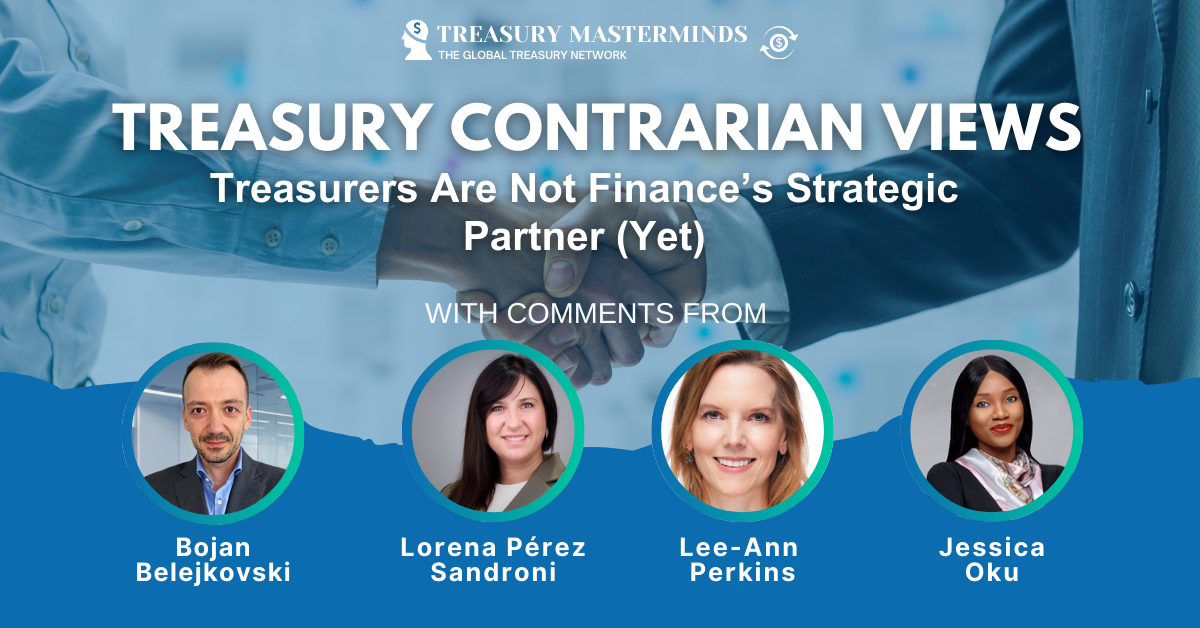
Treasurers often say they have “a seat at the table” and act as strategic advisors to the CFO. Industry conferences echo the same mantra: treasury is strategic. But here’s the contrarian view: In many companies, treasury is still seen as an operational function—not a true strategic partner. And admitting that might be the first step toward change.
Why Treasury Isn’t Seen as Strategic (Yet)
- Focus on Operations Over Strategy
- Too often, treasury is consumed by cash positioning, bank reconciliations, and compliance. These are essential tasks, but they keep the team in execution mode rather than strategy mode.
- Reactive, Not Proactive
- Treasurers frequently respond to crises (FX volatility, liquidity crunches) instead of shaping forward-looking strategies that anticipate change.
- Lack of Business Integration
- Treasury can become siloed from commercial teams, missing opportunities to link financial risk management with sales, procurement, or supply chain strategies.
- Limited Communication to the Board
- Unlike FP&A or corporate finance, treasury insights often don’t reach senior leadership in a way that drives decision-making.

The Path to Becoming Strategic
- Shift from Numbers to Narratives
- Treasury must translate exposures, liquidity scenarios, and risk models into clear business stories that CFOs and boards can act on.
- Own Data and Insights
- With access to real-time cash and risk data, treasury is uniquely positioned to deliver forward-looking insights that go beyond reporting.
- Partner with the Business
- By engaging procurement, sales, and operations, treasury can align financial policies with business realities—turning risk management into competitive advantage.
- Prove Value Through ROI
- Whether through reduced FX costs, optimized liquidity, or innovative financing, treasury should demonstrate measurable contributions to performance.
Let’s Discuss
- Do you agree that treasury is not yet a true strategic partner in most organizations? Why or why not?
- What steps have you seen treasury teams take to elevate their role?
- What would it take for treasury to consistently earn a seat at the strategic table?
We’ll gather views from CFOs, treasurers, and finance leaders—join the conversation and share your perspective!
COMMENTS

Lee-Ann Perkins, Treasury Masterminds Board Member, comments:
My answers are from the point of view of the treasury maturity model. While I wholeheartedly agree that treasury should, and deserves to be a trusted strategic partner, the reality from my perspective is that most smaller companies are not there yet. If the industry adopts a Chief Treasury Officer, we may get the traction and support we require.
Do you agree that treasury is not yet a true strategic partner? Why/why not?
Yes. Day-to-day cash ops, reconciliations, and compliance consume capacity; under-resourcing keeps treasury reactive, siloed from commercial teams, and off-key decision agendas, which are traits of an operational, not strategic, function.
What steps have you seen treasury teams take to elevate their role?
Elevate the function by strengthening operations by clarifying roles with a RACI matrix, segregating duties, and automating to free capacity. Manage real-time liquidity/FX data and scenario planning, which enables us to translate analytics into board-ready narratives. The aim is to prove ROI through lower FX costs, optimized liquidity, and innovative financing.
What would it take for Treasury to consistently earn a seat at the strategic table?
CFO sponsorship and funding; distinct front/middle/back-office roles; a modern, treasury-owned data stack; a standing C-suite/board cadence that turns exposures into business stories; and KPIs that tie actions to enterprise value.

Bojan Belejkovski, Treasury Masterminds Board Member, comments:
I agree treasury is often seen as operational rather than strategic. But let’s be honest, part of the problem lies outside treasury. There are still CFOs who don’t truly know what treasury is, what it should do, or how it can evolve as a discipline. If leadership defines treasury narrowly as cash positioning and compliance, the function will never be seen as a partner.
The turning point comes when treasurers begin owning real-time data, using AI to move from reactive reporting to predictive insights, and translating liquidity and risk into business-impact narratives. That’s when value becomes undeniable. But it also requires organizations, and CFOs in particular, to expand their view of treasury. Strategic partnership is a two-way evolution.

Lorena Pérez Sandroni, Treasury Masterminds Board Member, comments:
In my opinion, despite the evolution of treasury technology and access to data, many teams remain bogged down by manual processes, fragmented systems, and limited resources. But the real barrier isn’t just tools—it’s mindset. Too many treasury managers are reluctant to step out of their operational comfort zones. They focus on reporting exposures, reconciling accounts, and managing compliance, but struggle to “sell the story” behind the numbers—the strategic insights that could influence business decisions.
Treasury has a unique vantage point: it sees liquidity risks before they materialize, understands the financial pulse of the company daily, and has access to data that could shape forward-looking strategies. Yet, without strong leadership to elevate these insights, treasury remains reactive, not proactive.
To change this, we need a new kind of treasury leadership—one that:
- Champions’ transformation, even when resources are tight.
- Builds bridges with the rest of the business teams, embedding treasury into the business.
- Communicates in narratives, not just numbers, to influence senior stakeholders.
- Pushes for visibility, not just during crises, but as a consistent strategic voice.
Until we, treasury leaders, embrace this shift, the function will continue to be seen as operational support rather than a strategic partner. The opportunity is there—but it requires courage, vision, and a willingness to lead beyond transactional routines and into enterprise-wide impact.

Jessica Oku, Treasury Masterminds Board Member, comments:
Q1: Do you agree that treasury is not yet a true strategic partner in most organizations? Why or why not?
Yes. Many treasuries are still trapped in the “Operational Quadrant” of the Strategic Treasurer Impact Matrix (STIM framework I developed); managing transactions, reconciliations, and resolving daily liquidity issues. This drowns out their ability to be visible as strategic partners. We need more treasuries to move from back-office operators to a forward-looking enabler of growth and resilience.
Q2: What steps have you seen treasury teams take to elevate their role?
The most successful teams intentionally move into the “Influence & Insight” quadrants of the STIM framework. They automate repetitive tasks, implement real-time visibility tools, and deliver scenario modeling, funding strategies, and risk insights. They show how cash, liquidity, and funding decisions directly impact growth or resilience, and leadership listens to them.
Q3: What would it take for treasury to consistently earn a seat at the strategic table?
2 things: visibility and voice. Visibility comes from dashboards, clear KPIs, and proactive communication. Voice comes from bringing insights, not just numbers, that shape business decisions.
Also Read
- Treasury Contrarian View: Forecasting Accuracy Is Overrated
- Treasury Contrarian View: Should Treasury Operate Like a Startup?
- Treasury Contrarian View: Everyone Is Replaceable — But Some Are More Replaceable Than Others!
- Treasury Contrarian View: FX Policy — Too Rigid, Too Static?
- Treasury Contrarian View: Inflation Hedging — Should Treasury Even Try?
- Treasury Contrarian View: APIs in Treasury — Game-Changer or Just Another Integration Headache?
- Treasury Contrarian View: Should Treasury Really Own Working Capital Optimisation?
- Treasury Contrarian View: Do We Focus Too Much on Finance Backgrounds in Treasury Hiring?
- Treasury Contrarian View: Real-Time Payments — Do We Really Need Them in Treasury?
Join our Treasury Community
Treasury Mastermind is a community of professionals working in treasury management or those interested in learning more about various topics related to treasury management, including cash management, foreign exchange management, and payments. To register and connect with Treasury professionals, click [HERE] or fill out the form below to get more information.