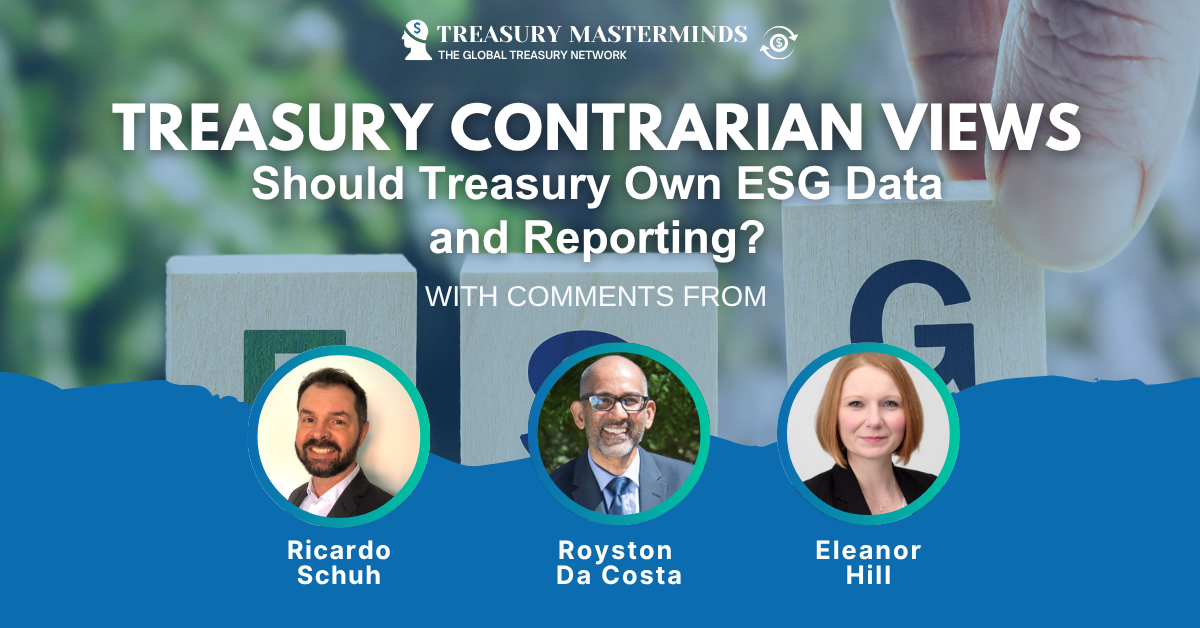
Environmental, Social, and Governance (ESG) reporting is becoming a critical expectation for companies worldwide. Regulators, investors, and stakeholders increasingly demand transparency. But here’s the contrarian question: Should treasury—not sustainability or finance—own ESG data and reporting?
The Case for Treasury Ownership
- Treasury Owns the Data Infrastructure
- Treasury already manages complex financial data flows across banks, systems, and subsidiaries. Adding ESG metrics to the mix may be a natural extension.
- Investor and Lender Expectations
- ESG-linked loans, green bonds, and sustainability-linked financing are growing fast. Treasury manages these instruments and is already engaging with lenders and rating agencies.
- Integration with Risk Management
- ESG factors (climate risk, governance standards, social compliance) are increasingly tied to financial risk. Treasury is well-positioned to integrate these into enterprise risk frameworks.
- Credibility with External Stakeholders
- Treasury’s reputation for objectivity and precision could strengthen trust in ESG disclosures, especially when compared to softer, narrative-driven reporting.
The Case Against Treasury Ownership
- Lack of Subject Matter Expertise
- Treasury may know financing, but ESG involves carbon accounting, supply chain ethics, and social responsibility—areas outside traditional treasury expertise.
- Risk of Dilution
- Treasury already has a heavy workload with liquidity, FX, and funding. Adding ESG reporting could dilute focus and strain resources.
- ESG is Broader Than Finance
- ESG reporting requires cross-functional input (HR, procurement, operations). Treasury can’t (and shouldn’t) own areas it doesn’t control.
- Potential Conflicts of Interest
- If treasury owns ESG data tied to financing, will the numbers be presented with a bias toward securing better terms? Independence matters.
A Collaborative Model
Perhaps the best approach isn’t treasury owning ESG outright, but treasury playing a critical role:
- Treasury as the data integrator, ensuring ESG metrics are reliable and finance-grade.
- Sustainability teams providing subject matter expertise, especially in non-financial areas.
- Finance ensuring governance and assurance, making ESG part of mainstream corporate reporting.
Let’s Discuss
- Should treasury own ESG reporting, or just support it?
- What role does your treasury team currently play in ESG-linked financing and disclosures?
- How can ESG data be made as reliable and auditable as financial data?
We’ll share perspectives from treasurers, CFOs, and sustainability leaders—join the conversation!
COMMENTS

Ricardo Schuh, Treasury Masterminds Board Member, comments:
I believe that ESG should be led by a dedicated professional or function within the organization, given its scope goes far beyond financial reporting. While Treasury can add significant value in ensuring data integrity, governance, and technical alignment with financial markets, ESG encompasses a broader set of dimensions such as environmental metrics, supply chain ethics, and social responsibility. In my view, Treasury’s role should be to support and challenge the ESG function, ensuring that information is reliable, finance-grade, and presented in a way that meets the expectations of banks, investors, and rating agencies. This partnership creates a stronger framework where financial expertise complements, but does not replace, subject matter specialization.
From my practical experience, banks increasingly place heavy demands on companies in terms of ESG-related disclosures, particularly when structuring loans, sustainability-linked instruments, or green financing. In these situations, Treasury often acts as the interface with financial partners, but our effectiveness relies heavily on the dedicated ESG team. Their expertise, agility, and ability to provide accurate content, supporting materials, and standardized forms have been critical in meeting external requirements on time and with credibility. This collaborative approach ensures that Treasury maintains its focus on financial strategy while ESG professionals drive the broader agenda, together reinforcing the company’s overall transparency and sustainability positioning.

Eleanor Hill, Founder, Treasury Rebel, comments:
From what I’ve seen in the market, this very much depends on the company and their organisational structure (including whether there is a standalone sustainability team).
Interestingly, a couple of years ago, I did see one or two treasury teams being tasked with ESG oversight and reporting – admittedly quite rare cases. But I haven’t encountered any others since then. The current political climate and rhetoric around ESG certainly isn’t helping, either.
If I had to come down on one side, I’d probably say treasury should support ESG reporting rather than own it outright. Treasury teams already have a tremendous amount on their plates and adding full ownership of ESG reporting could risk spreading precious resources far too thinly. It would also require some upskilling in most treasury functions as the ins and outs of a niche area like sustainability can be complex.
That said, I do believe that (where they can and want to) treasury professionals have a valuable role to play, particularly in pushing banks and vendors for better reporting on the sustainable aspects of their products and services. Treasury leaders – especially in large organisations – are well positioned to make those demands, given their relationships and the commercial leverage they hold.
I’d love to see more treasurers asking for greater ESG transparency and accountability from their counterparties going forward – and this should help increase the value that treasury can bring to ESG reporting. A virtuous circle!

Royston Da Costa, Treasury Masterminds Board Member, comments:
Treasury should not be the sole owner of all ESG reporting. But Treasury should be a co-owner and the lead steward for finance-linked parts of ESG reporting — especially anything that affects capital markets, debt instruments, financed emissions, financial disclosures, assurance-ready controls, and the numbers that feed investor/creditor decisions. The best practical model is a clear cross-functional (hub-and-spoke) model where Sustainability owns operational ESG strategy and data collection, Finance (CFO/Controllership) owns integrated reporting controls and accounting alignment, and Treasury owns the finance-market, funding and financed-emissions disclosures and assurance controls that relate to capital, liquidity and counterparty exposures
1) Why this question matters to Treasury
- Capital & pricing impact: ESG disclosures affect how investors and banks price your bonds, loans and derivatives (e.g., green bonds, sustainability-linked loans/bonds). Treasury manages those instruments — so errors or gaps hit funding cost and covenant compliance.
- Financed emissions & portfolio risk: Lenders and investors expect reporting of emissions linked to financed activities (Scope 3 / financed emissions) — treasury data & product flows matter here.
- Controls & assurance: Treasury already runs strong finance controls and close processes — valuable for audit-ready ESG numbers.
- Regulatory risk: New rules (e.g., EU CSRD, ISSB/IFRS S1 & S2) change what must be disclosed and assured; treasury must ensure disclosures that touch funding and financial statements are compliant.
2) Key external standards and rules
- ISSB / IFRS S1 & S2: global baseline for sustainability disclosures focusing on governance, strategy, risk management, and metrics/targets (close alignment to TCFD). These are rapidly being adopted by jurisdictions and investors expect alignment.
- EU CSRD: requires much broader sustainability reporting and independent assurance in scope — affects companies operating in/with EU jurisdictions.
- Green / Sustainability-Linked Principles (ICMA): market best practice for green bonds and sustainability-linked instruments — they set disclosure and reporting expectations for issuers (what Treasury will publish for bond covenants & KPI monitoring).
- PCAF: accepted methodology for measuring financed emissions across asset classes — crucial when disclosing financed emissions tied to loans, bonds and investments.
3) Ownership models — what they look like and how they affect Treasury
- Sustainability-led model
- Description: Sustainability/ESG team owns reporting end-to-end; Finance/Treasury provide inputs.
- Pros: Deep subject matter expertise; strong link to operations.
- Cons for Treasury: Risk of weak controls/assurance on finance-linked metrics; disconnected from funding narratives.
- Finance (CFO)-led model
- Description: Finance leads consolidated ESG reporting (often with Sustainability as data owner).
- Pros: Strong controls, audit readiness, integration with financial reporting and planning. Good for investor communications.
- Cons: Risk Sustainability becomes siloed; may lack operational nuance.
- Treasury-owned model
- Description: Treasury leads ESG reporting.
- Pros: Tight control of funding narratives, KPI linkage to capital instruments.
- Cons: Treasury may lack operational data access and broader sustainability expertise — risky to own entire report alone.
- Hub-and-spoke (recommended)
- Description: Sustainability is the data & strategy hub; Finance provides consolidation/controls; Treasury leads finance and capital-market disclosures (green bonds, financed emissions, SLL/KPI compliance). Cross-functional steering group and single CRR (Corporate Reporting/Risk) owner for timelines and assurance.
- Pros: Combines best of all worlds; clear RACI reduces gaps.
- Cons: Requires strong governance and change management.
Recommendation: adopt the hub-and-spoke with explicit RACI for each reporting element (I = Information owner, R = Responsible lead, A = Approver, C = Contributor).
4) Dimension-by-dimension breakdown — who should lead, who should contribute, what Treasury must do
I’ll go through the main dimensions and for each say: Lead, Treasury role, Why it matters.
A. Strategy & targets (net-zero, ESG strategy)
- Lead: Sustainability (with Executive Sponsor / CEO).
- Treasury role: feed financial implications (capex/opex, funding needs, transition costs), stress-testing outcomes, liquidity modelling.
- Why: Targets affect capex and funding needs; Treasury must plan capital structure and liquidity.
B. Governance disclosures (board oversight, committees)
- Lead: Legal & Sustainability (with CFO oversight).
- Treasury role: document treasury committee role, sign off on funding-linked governance, provide attestations for financial controls.
- Why: Investors expect to see how board-level governance aligns with funding decisions.
C. Metrics & targets (GHG, KPIs, financed emissions)
- Lead: Sustainability for operational metrics; Treasury leads financed-emissions & instrument-linked KPIs.
- Treasury role: calculate/report financed emissions (PCAF), validate KPI metrics used in SLLs/SLBs, produce issuer-level reconciliations.
D. Data collection & systems
- Lead: Sustainability/IT for operational data; Finance/Treasury for financial data integration.
- Treasury role: ensure ERP/treasury systems feed necessary cashflow, loan, bond and counterparty data into ESG data warehouse; own data lineage and reconciliation for funding instruments.
E. Accounting & financial statement alignment
- Lead: Finance / Controllership.
- Treasury role: provide debt & derivatives data, ensure disclosures about covenant adjustments and contingent liabilities are accurate and reconcile to statutory accounts.
F. External reporting (ESG report, investor presentations, bond prospectuses)
- Lead: Finance + Sustainability (joint).
- Treasury role: author sections on funding strategy, green bond use-of-proceeds, SLB/KPI mechanics, and financing-related assurance notes. Must ensure consistency with prospectuses/term sheets.
G. Regulatory compliance (CSRD, ISSB/IFRS S1 & S2, local rules)
- Lead: Legal & Compliance with Finance/Sustainability input.
- Treasury role: support by mapping required disclosures to treasury-controlled data and attestations.
H. Assurance & controls (internal and external)
- Lead: Finance (internal audit) + external assurance providers.
- Treasury role: provide auditable trails for funding and KPI data; implement controls in treasury processes (e.g., dual signoffs, reconciliations, change logs) to enable limited/reasonable assurance.
I. Investor relations & credit markets
- Lead: IR + Treasury (joint).
- Treasury role: deliver the financing narrative, respond to investor due diligence on financed emissions, provide documentation for green bond/SLB KPIs.
J. Capital products (green bonds, SLBs, loans)
- Lead: Treasury.
- Treasury role: structure instruments, negotiate KPI definitions with lenders/investors, ensure reporting cadence and verifiable KPIs (and penalties/step-ups are correctly measured).
K. Risk management & scenario analysis (transition & physical risk)
- Lead: CRO / Risk with Sustainability input.
- Treasury role: integrate climate scenario outputs into liquidity stress tests, counterparty risk assessments, and capital planning.
L. Incentives & remuneration linkages
- Lead: HR & RemCo (Remuneration Committee).
- Treasury role: quantify financial impacts of incentive metrics, ensure metrics used in incentive plans reconcile to disclosed KPIs.
M. M&A, due diligence & disclosures
- Lead: Strategy / Corporate Development with Sustainability & Finance inputs.
- Treasury role: financial valuation sensitivity to transition risk, disclosure of any financing-related contingent liabilities.
5) Practical RACI (example) — core reporting components
(Abbreviated; expand for your organisation)
- Operational emissions (Scope 1 & 2): R = Sustainability, A = Head of Sustainability, C = Facilities/Operations, I = Treasury
- Financed emissions (Scope 3 – financed): R = Treasury (data assembly & finance reconciliation) + Sustainability (methodology), A = CFO, C = Risk, Legal, I = Board
- Green bond reporting: R = Treasury, A = CFO, C = Sustainability, Legal, I = IR
- Overall ESG report & assurance: R = Finance (consolidation)/Sustainability (content), A = CEO/CFO, C = Treasury, Internal Audit
6) Pros & cons for Treasury owning ESG reporting (straightforward)
Pros
- Tight control over investor-facing finance disclosures and KPIs.
- Easier assurance readiness because treasury already runs robust financial controls.
- Faster interaction with banks/investors on deal-specific ESG clauses.
Cons
- Risk of missing operational accuracy or sustainability nuance.
- Resource and capability gap — treasury often lacks full sustainability expertise.
- Potential turf conflicts with Sustainability or Finance if governance unclear.
Net: Treasury should own finance-linked ESG reporting and be a core co-owner of consolidated reporting. Not the only owner.
Also Read
- Treasury Contrarian View: Forecasting Accuracy Is Overrated
- Treasury Contrarian View: Treasurers Are Not Finance’s Strategic Partner (Yet)
- Treasury Contrarian View: Should Treasury Operate Like a Startup?
- Treasury Contrarian View: Everyone Is Replaceable — But Some Are More Replaceable Than Others!
- Treasury Contrarian View: FX Policy — Too Rigid, Too Static?
- Treasury Contrarian View: Inflation Hedging — Should Treasury Even Try?
- Treasury Contrarian View: APIs in Treasury — Game-Changer or Just Another Integration Headache?
- Treasury Contrarian View: Should Treasury Really Own Working Capital Optimisation?
- Treasury Contrarian View: Do We Focus Too Much on Finance Backgrounds in Treasury Hiring?
- Treasury Contrarian View: Real-Time Payments — Do We Really Need Them in Treasury?
Join our Treasury Community
Treasury Mastermind is a community of professionals working in treasury management or those interested in learning more about various topics related to treasury management, including cash management, foreign exchange management, and payments. To register and connect with Treasury professionals, click [HERE] or fill out the form below to get more information.